
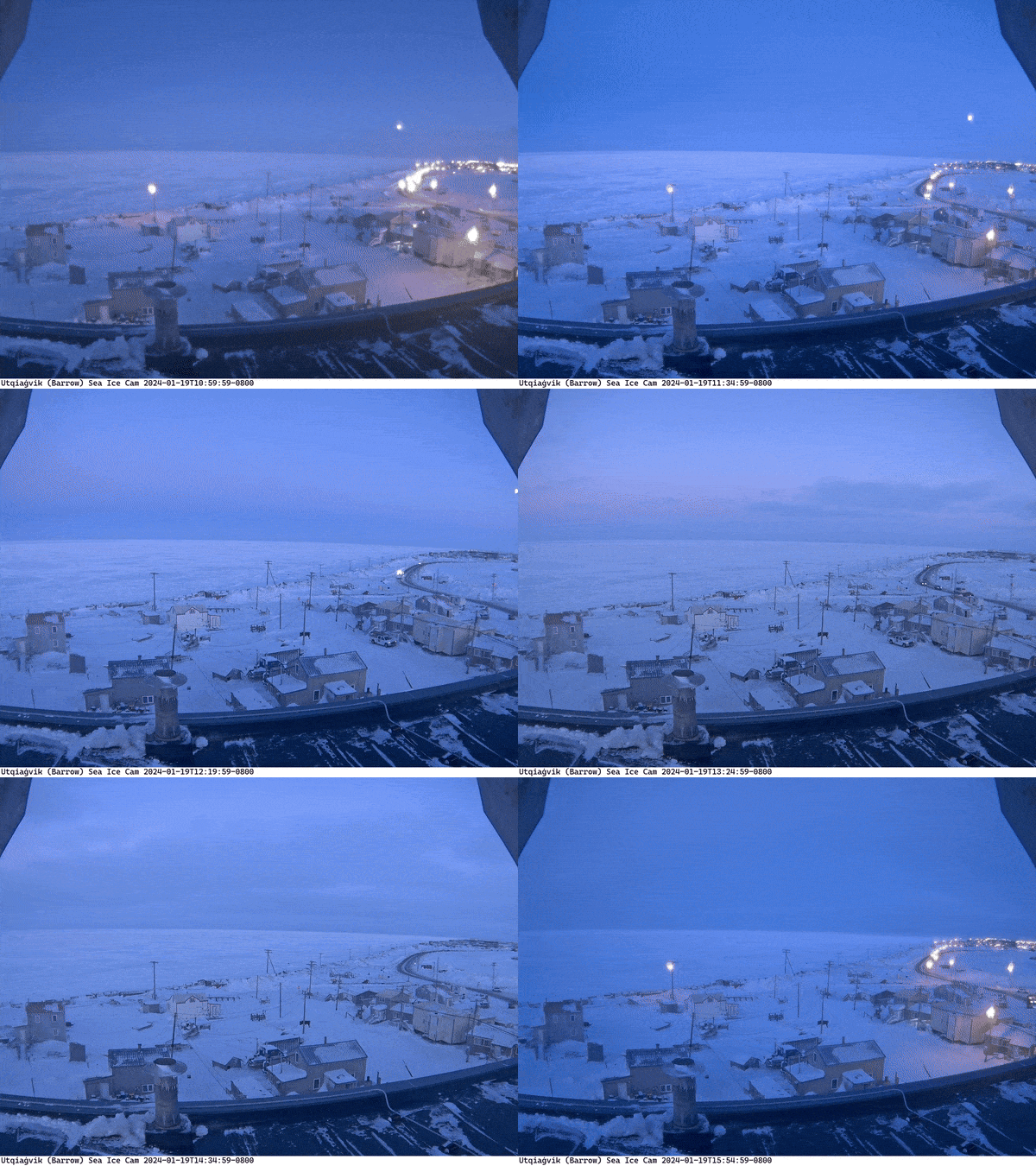
The Utqiaġvik (Barrow) Sea Ice Webcam is operated by the University of Alaska Fairbanks. This timelapse from Jan. 19, 2024, shows a glimpse of the polar night.
The sun will rise for the first time in more than two months on Tuesday afternoon in America’s northernmost town.
At 1:09 p.m. AKST Tuesday, Jan. 23, 2024, sunrise will take place for the first time since Nov. 18 in Utqiagvik, Alaska, pronounced oot·kee·aag·vuhk, formerly known as Barrow. The town is home to a population of more than 4,000 people, and it is the farthest north town in The Last Frontier. It is so far north that it lies within the Arctic, situated approximately 330 miles north of the Arctic Circle.
The dark period, which lasts about 67 days, is known as polar night. The end of the polar night is celebrated with traditional dancing to welcome the sun back.
“The return of the sun signifies a new beginning. It signifies a new season. It signifies the start of something new. And it also signifies the return of all the animals that come back to northern Alaska,” Natasha Itta, community education facilitator at Iḷisaġvik College, told Anchorage Daily News during last year’s sunrise after polar night. “My tuttu (caribou) are coming back, my fish are coming back, our spring whales are coming back, and our geese and our ducks.”
“Everything is eventually going to come back, and for me, that’s exciting,” she said. “You just understand that we have to go through the dark season in order to get to the light.”
Polar night
During the polar night, the sun does not rise above the horizon, which happens at both poles of the Earth at different times of year. The phenomenon occurs because the Earth rotates the sun at a 23.5-degree tilt. That means that the North Pole tilts away from the sun during winter, which is why the Earth’s closest star, the sun, is obscured.
However, it is not dark during the entire polar night. The civil twilight brings dim light to the skies — when clouds are absent — for a few hours of the day since the sun is about 4.5 degrees below the horizon, Rick Thoman, a climate and weather expert with the Alaska Center for Climate Assessment and Policy, explained to Anchorage Daily News. The length of civil twilight varies during the polar night, lasting about six hours after it begins and around three hours around the winter solstice.
“It ends up being this really beautiful time,” former Utqiagvik resident Kirsten Alburg told AccuWeather of her experience of the polar night. “You have the northern lights and it gets cold, but there are so many lights that are out in the town and it makes everything sparkle.”
The average high temperature dips to 5.5 degrees below zero Fahrenheit at Barrow Airport in February, according to NOWData, the National Oceanic and Atmospheric Administration’s online weather data. The lowest temperature ever recorded at the airport, which began keeping records in 1901, was 56 degrees below zero Fahrenheit set in February 1924. On the other hand, the highest temperature ever recorded was 79 degrees Fahrenheit in July 1993.
Midnight sun
In the summer, the midnight sun shines uninterrupted for 24 hours per day for 80 days, according to Alaska.org. This is due to the North Pole tilting toward the sun during this time of the year, and so the sun never slips below the horizon.
Spotlight on Utqiagvik: ‘The rooftop of the world’
The town formerly known as Barrow restored its original name Utqiagvik back in 2016, according to NPR. It is a name in the traditional Iñupiaq language spoken across much of northern Alaska meaning “a place to gather wild roots.”
It’s also known as “the rooftop of the world,” according to the Iñupiat Heritage Center located in Utqiagvik and part of the National Park Service.
The Iñupiat Heritage Center offers a virtual tour of its exhibits that shares the history, culture and language of the tribe, who have lived and thrived in the region for thousands of years “in one of the most extreme climates on Earth, hunting the bowhead, or ‘Agviq.'”

A photo of a whalebone arch in Utqiagvik, Alaska, known for its history in whaling. (Warren McKenzie)
According to the Iñupiat Community of the Arctic Slope (ICAS), a Regional Alaska Native tribal government governed by the Indian Reorganization Act of 1934 and the ICAS Constitution, amended by the community of the Iñupiat people, the region is vast and unique, with a population of 9,832 as of July 2019.
“Within our boundaries are some of North America’s most unique regions. Bordered by the foothills of the Brooks Range to the south and the Arctic Ocean on the north and west, and Canada to the east, the area encompasses 89,000 square miles. Fifteen percent of Alaska’s land mass lies in this region, all of which is located above the Arctic Circle,” ICAS states on its website.
The remoteness of the region is highlighted by the fact that there are no roads into or out of Utqiagvik.

The northern lights glow over northern Alaska.
During the polar night, the northern lights often dance in the sky above the region.
 Meghan Mussoline